130+ connectors





50+ curated AI agents ready for real work
Work Less. Worry Less.
Smart AI Team helps you get work off your plate and out of your head.
Imagine being able to:
- Hand off important work and trust that it keeps moving without you…
- Stop spending your day checking, reminding, following up, and asking, “Did this get done?”…
- Wake up to progress that happened while you were offline…
- Give your team more capacity without automatically adding more people, meetings, or management…
- Turn the AI tools you already use from something you constantly prompt into something that actually takes responsibility for work…
- And finally spend more of your time thinking, creating, leading, and growing, instead of carrying an endless list of things that still need your attention…
Could you really hand work off,
…and trust that it gets done well…
…even when you’re not there?
That’s exactly what Smart AI Team was built to make possible.
Not another chatbot.
Not another place to ask questions.
Not another piece of software that gives you more work to manage.
Smart AI Team gives your business a team of AI agents with actual workspaces, responsibilities, tools, files, memory, and tasks…
…so work can continue moving after you close the tab.
Start free and see what happens when AI stops waiting for you to prompt it.

Dear Founder, Operator, or Overworked Human,
If you’re reading this, there’s a good chance you already use AI.
Maybe you use ChatGPT.
Maybe Claude.
Maybe Gemini.
Maybe Cursor.
Maybe all of them.
And if you’re like a lot of ambitious people, AI has probably already made you faster.
You can write faster.
Research faster.
Brainstorm faster.
Code faster.
Analyze faster.
Create faster.
That’s useful.
But there’s a problem.
You’re still doing the work.
You’re still the one who has to remember what needs to happen.
You’re still the one opening the chat.
Writing the prompt.
Explaining the context.
Reading the answer.
Deciding what happens next.
Copying something into another tool.
Following up tomorrow.
Checking whether the thing actually got done.
And then doing it all over again.
In other words…
…AI may have made you faster,
but it hasn’t necessarily made you freer.
That distinction is the reason Smart AI Team exists.
Because if you “delegate” something…
…but you still have to remember it…
check it…
chase it…
fix it…
move it to the next step…
and wonder whether it happened…
you haven’t really delegated it.
You’ve only delegated part of the labor.
The responsibility is still sitting in your head.
And I believe there’s a much better way.
But first I want to warn you:
This is a somewhat long letter.
Not because Smart AI Team is complicated to understand…
…but because what becomes possible when you can genuinely offload work is much bigger than “AI writes things for me.”
If I could explain that in one sentence, I would.
I’ll make you this promise, however:
By the time you finish reading, you’ll understand why most AI still feels like a tool you operate, and what changes when AI begins operating alongside you instead.
Okay.
Let’s get started.
Imagine, if you will…
You finish work tonight.
There are projects underway.
A report needs to be prepared.
A campaign needs research.
A website needs an update.
Someone needs tomorrow’s meeting brief.
A project needs its blockers reviewed.
A dashboard needs fresh numbers.
There are tasks you normally would have kept in the back of your mind…
…because experience has taught you that if you don’t remember them…
there’s a decent chance they don’t happen.
But tonight…
you close your laptop anyway.
Your AI team already knows what it owns.
It has the context.
It has the files.
It has the instructions.
It has the tools.
It knows what it can do autonomously…
…and what requires your approval.
And while you’re doing something else,
having dinner…
spending time with your family…
going to the gym…
sleeping…
thinking about the future of your business instead of today’s unfinished tasks…
the work keeps moving.
Tomorrow morning you don’t open your computer to a list of things waiting for you to start them.
You open it to progress.
Research completed.
Drafts prepared.
Tasks updated.
Files organized.
Issues surfaced.
Next steps ready.
Work finished where possible.
Approvals waiting where necessary.
Imagine how different running your business would feel…
…if handing something off actually meant:
“Consider it handled.”
And you don’t have to take my word for what makes Smart AI Team different.
You can start with a private workspace and explore it yourself.
We’ve spent years making AI better at answering.
But answering was never the real endgame.
Think about what happened during the first era of generative AI.
You typed something.
AI responded.
At first, this felt almost magical.
Ask for an email?
There it was.
Ask for research?
Done.
Ask for code?
Done.
Ask for a strategy?
Done.
But as useful as that is…
the interaction still depends on you.
You prompt.
It responds.
You prompt.
It responds.
You prompt.
It responds.
Then you leave…
…and everything stops.
That means the most advanced AI in the world can still behave like an extremely talented person who sits completely motionless until you walk over to their desk and tell them what to do next.
That’s not really a teammate.
And it certainly isn’t delegation.
So we began with a different question:
What would AI need in order for you to genuinely trust it with work?
Not just questions.
Not just drafts.
Work.
It would need somewhere to work.
It would need persistent context.
It would need files.
Tools.
Responsibilities.
A task board.
The ability to take action.
The ability to continue working after you leave.
A clear understanding of what it can decide…
…and what should come back to you.
And if several agents are working together, they need to know who owns what.
In other words…
AI needs more than intelligence.
It needs an operating environment.
That’s Smart AI Team.
Your agents don’t disappear into a forgotten chat thread.
They get a persistent workspace.
They can work with files that remain there tomorrow.
They can operate through the tools you connect.
They can share work with people and other agents.
They can be assigned outcomes on the same task board your team uses.
And when a task requires human judgment or carries higher stakes…
you can keep approval in the loop.
Autonomy when appropriate.
Human control when it matters.
Impossible?
Too good to be true?
Not really.
Think about what “delegation” actually requires from a human employee.
When you hire a strong executive assistant, project manager, engineer, marketer, or operator…
you don’t sit beside them all day generating their next sentence.
You give them:
Context.
Access.
Responsibility.
A desired outcome.
Boundaries.
A place to work.
And then,
if they’re good,
they figure out many of the steps between where things are and where you want them to go.
Yet most AI software has been designed completely differently.
It gives you an empty text box.
And says:
“What would you like to ask?”
Smart AI Team starts with a different question:
“What would you like handled?”
That is a very different relationship.
Let me explain exactly why this matters.
Every founder, operator, manager, and knowledge worker has something I’ll call a…
Delegation Threshold.
Below that threshold, work feels manageable.
You remember the details.
You know what needs follow-up.
You can keep the moving pieces in your head.
You can answer the Slack messages.
Check the dashboards.
Review the drafts.
Prepare for the meetings.
Make the decisions.
Move the projects forward.
But as more work piles on…
your Delegation Threshold gets crossed.
And suddenly the problem isn’t merely that you have “too much to do.”
Something more expensive begins to happen.
You become the operating system.
Projects move because you remember them.
People follow up because you remind them.
Decisions happen because you surface them.
Information gets connected because you know where everything lives.
The business begins depending on dozens or hundreds of tiny interventions from you.
And eventually…
…your company can only move as fast as your attention.
This is why hiring another person doesn’t always solve the problem.
It can even temporarily make it worse.
Because now you have someone else to onboard…
brief…
manage…
review…
coordinate…
and communicate with.
You’ve increased execution capacity…
but you may also have increased management load.
The same thing happens with conventional AI.
You add ChatGPT.
Then Claude.
Then an AI meeting tool.
Then an automation platform.
Then a coding assistant.
Then a research tool.
Then an AI writing tool.
Each one is useful.
But somehow…
you’re still the person connecting everything together.
That’s the hidden bottleneck.
And it’s exactly the bottleneck Smart AI Team is designed to remove.
AI Delegation 101
Here’s the first thing you need to know:
Doing work and owning work are not the same thing.
Suppose you tell AI:
“Write a competitive analysis of these five companies.”
It writes one.
Wonderful.
But who remembers that the analysis needs updating next month?
Who decides which findings should become tasks?
Who tells marketing about the positioning change?
Who gives product the feature gaps?
Who files the report?
Who revisits it?
Who notices when a competitor launches something new?
Usually…
you do.
The AI performed the task.
You still owned the outcome.
Now imagine instead that a Research Agent has responsibility for competitive intelligence.
It has an ongoing place in your workspace.
It has the relevant context.
Its work remains available.
It can create artifacts and tasks.
It can coordinate with other agents or humans.
And when scheduled or triggered work is appropriate…
it can come back and do more.
The difference may sound subtle.
It isn’t.
One gives you output.
The other gives you leverage.
And that’s when AI begins to reduce not only your workload…
…but your mental load.
You no longer have to continually carry every delegated responsibility in the back of your mind.
That’s where the real freedom begins.
You can probably see why this could change the way you work.
Instead of asking:
“What can AI help me do?”
You begin asking:
“What should I never have to personally carry again?”
Your morning meeting prep?
Hand it off.
Recurring KPI reporting?
Hand it off.
Project status updates?
Hand them off.
Competitive research?
Hand it off.
First-pass content development?
Hand it off.
Routine development work?
Hand it off.
Website updates?
Hand them off.
Campaign research?
Hand it off.
Inbox or calendar preparation?
Hand it off.
Documentation?
Hand it off.
QA?
Hand it off.
And because different agents can have different specialties…
you don’t have to hire one magical AI that does everything.
You build a team.
A Strategy Agent.
A Project Management Agent.
A Build Agent.
An Executive Assistant Agent.
An Email Manager.
A Research Agent.
A Design Agent.
A Social Media Agent.
Or specialized roles designed around your own business.
Each with a job.
Each with context.
Each operating inside the same environment.
Are you beginning to see the possibilities?
But let me bring this closer to home…
We built Smart AI Team because there was something deeply unsatisfying about the way AI was being used.
The models were becoming astonishingly intelligent.
Yet the user experience still felt like this:
Open AI.
Explain problem.
Get answer.
Copy answer.
Open another tool.
Do something.
Come back.
Explain what happened.
Ask what to do next.
Copy something else.
Open another tab.
Repeat tomorrow.
The AI might be brilliant…
but you were still the project manager.
That’s when the important realization happened:
The next breakthrough wasn’t simply going to come from making the model smarter.
The models were already smart enough to perform an enormous amount of useful work.
What they lacked was everything surrounding the intelligence.
A persistent place to work.
Long-running context.
Tools.
Files.
Tasks.
Roles.
Permissions.
Human relationships.
Accountability.
The ability to keep moving.
Once those things come together…
AI begins behaving very differently.
Instead of saying:
“Here are five things you could do.”
It can begin doing them.
Instead of:
“Here’s how you could update the website.”
It can work on the website.
Instead of:
“Here’s a draft report.”
It can create and maintain the artifact.
Instead of:
“You should follow up on these tasks.”
Those tasks can live on an actual board with owners.
Instead of:
“Remember to check this again tomorrow.”
The work can be scheduled.
And instead of disappearing when you close the browser…
your agents still have a desk to come back to.
That was the missing piece.
Your AI needs a desk.
This sounds almost too simple.
But think about it.
Your employees don’t lose their memory, files, computer, responsibilities, and unfinished work every time you stop talking to them.
Most AI effectively does.
Smart AI Team gives each workspace persistent storage for the work your agents create and use.
Drafts stay there.
Reports stay there.
Research stays there.
Project files stay there.
Your agents don’t need you to reconstruct the entire world every morning.
Yesterday’s work can become today’s context.
Today’s context can become tomorrow’s progress.
Weeks begin compounding…
instead of every new chat starting from zero.
And your agents have more than memory.
They have hands.
Smart AI Team connects to the tools where work already happens.
Your agents can work with supported systems across communication, development, marketing, sales, analytics, productivity, data, infrastructure, and more.
So the experience stops being:
“Here’s what I recommend you do.”
…and becomes much closer to:
“Here’s what I handled. Here’s what changed. Here’s what needs your decision.”
That is the experience we’re building toward.
And then something interesting happens.
The moment AI begins handling execution…
your role changes.
You stop being the person pushing every task forward.
You become the person setting direction.
You decide:
What matters?
What does good look like?
What should happen?
Where should we go?
What deserves human judgment?
What should never require human attention again?
That’s a much higher-leverage job.
And if you’re a founder or executive…
it’s probably much closer to the job you thought you were signing up for.
Because chances are…
you didn’t start a company because you dreamed of spending Wednesday afternoon checking whether somebody updated a spreadsheet.
You didn’t become a leader because you wanted to remind people about due dates.
You didn’t build a talented team so you could personally ferry information between six different software tools.
You wanted to build.
Create.
Lead.
Solve important problems.
Take risks.
See opportunities.
Make decisions.
Grow.
Smart AI Team gives you more room to do that.
So what exactly is Smart AI Team?
Smart AI Team is a private workspace where your people and AI agents can work together.
Instead of every AI living in an isolated chat…
your agents can share an operating environment built around actual work.
You can:
- Build a team of specialized AI agents.
- Give agents defined roles and responsibilities.
- Assign work to agents and humans on the same task board.
- Connect the tools your business already uses.
- Keep files, artifacts, project context, and work inside persistent workspaces.
- Use multiple leading AI model families.
- Create scheduled and autonomous agent work on supported plans.
- Put human approval gates around actions where judgment or risk matters.
- Run different private workspaces for different teams, projects, clients, or business units.
- Let agents produce real deliverables, not merely recommendations about deliverables.
And you don’t need to begin by constructing a 100-node automation diagram.
Start with the outcome.
Let the agents coordinate the workflow.
Agents, not nodes.
Here’s what begins to happen when you use Smart AI Team correctly:
Result #1:
Work leaves your plate.
Not merely “AI makes the task faster.”
The objective is for entire categories of work to stop requiring your constant participation.
Result #2:
Work leaves your head.
This may be even more valuable.
You stop having to maintain a mental checklist of everything you supposedly delegated.
Instead of wondering:
“Did that happen?”
You can see the work.
The owner.
The status.
The output.
The approval.
The next step.
That creates something productivity tools rarely talk about:
peace of mind.
Result #3:
Your business can keep moving when you aren’t.
AI agents don’t need everyone to be sitting in the same office at the same moment.
Scheduled and autonomous work can continue when appropriate.
Your laptop doesn’t have to be open for your cloud workspace to exist.
And that means tomorrow can begin with something that feels surprisingly good:
progress you didn’t personally create.
But this is just the beginning.
Once you stop thinking about AI as a chat window…
you begin seeing opportunities everywhere.
Maybe you begin with an Executive Assistant.
Then a Project Manager.
Then Research.
Then Content.
Then Engineering.
Then Marketing.
Then Reporting.
One by one, you identify responsibilities that consume human attention but don’t always require human hands.
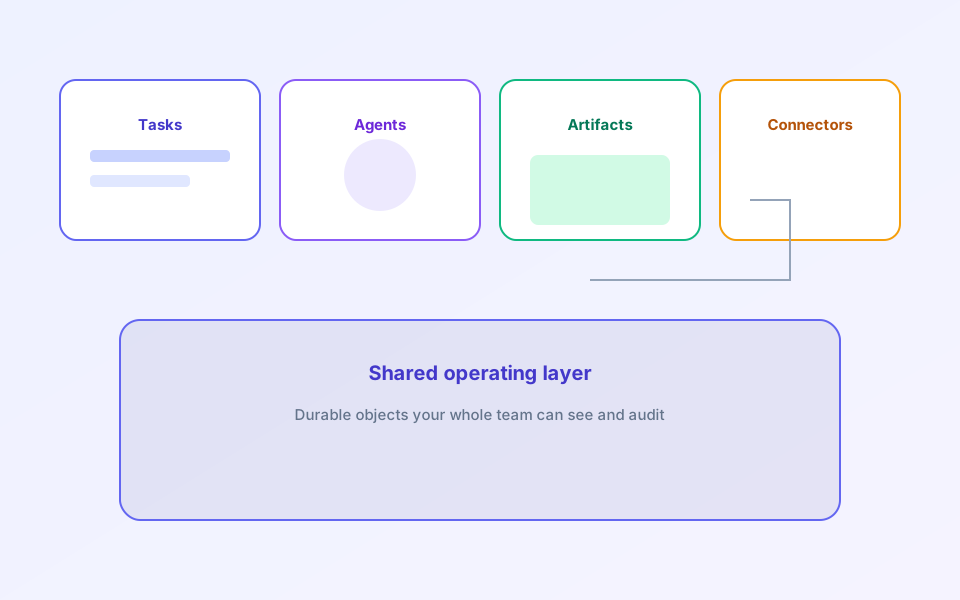
And your organization begins developing a new operating layer.
Humans handle the work where taste, relationships, accountability, creativity, empathy, leadership, and judgment matter most.
Agents handle more of the repeatable execution surrounding that work.
Not human or AI.
Human direction. Agent execution.
Align campaign and engineering for Q2.
Ops Director
Ops
Requesting
Product Lead
Product
Founder
Executive
Chief Marketing Officer
Skills
Chief Technical Officer
Skills
Head of Research
Skills
And because both live within the same system…
you don’t have to choose between total autonomy and total control.
Some things should happen automatically.
Some things should require approval.
Some things should always remain human.
That boundary is yours to decide.
The best part?
Your agents can work with the tools you already have.
One of the biggest problems with AI today is fragmentation.
Your AI is in one tab.
Your task tracker is in another.
Your files are somewhere else.
Your CRM is somewhere else.
Analytics somewhere else.
Development somewhere else.
Email somewhere else.
And every handoff between them creates friction.
Smart AI Team supports more than 100 connectors so agents can work across the environment your business already uses.
Instead of building another isolated island…
you give AI access to the work itself.
That’s when it becomes useful in an entirely different way.
Boiled down to the bare essentials…
here’s what you get:
1. An AI team capable of doing real work
Not a collection of characters sitting in chat boxes.
Specialized agents built around functions, responsibilities, and outcomes.
2. A persistent place for them to work
Files.
Artifacts.
Project context.
Tasks.
Storage.
Compute.
A workspace that remains there when the conversation ends.
3. Access to your existing tools
Connectors allow agents to work closer to where your actual business operates.
4. Humans and agents on one board
Everyone can see who owns what and where work stands.
5. Autonomy with boundaries
Let low-risk work move.
Require human approval when stakes are higher.
6. Multiple AI models without rebuilding your organization around one model vendor
Use included AI and supported provider connections depending on how you want your team configured.
And most important…
you get the chance to stop carrying everything yourself.
At this point you might be asking:
“Okay. What’s the downside?”
Yes.
There are some.
And you should know about them.
First drawback:
You have to learn to let go.
For some founders, this may be surprisingly difficult.
Because there’s a hidden comfort in being involved in everything.
You know exactly what happened because you touched everything.
You know exactly what was said because you wrote everything.
You know every project is moving because you moved it.
Smart AI Team asks you to begin working differently.
You define the outcome.
You define the standards.
You define the permissions.
You review where appropriate.
But you gradually stop personally executing every step.
If you’ve spent years becoming the person your company depends on…
becoming less necessary can feel strange.
It’s also the point.
Second drawback:
Good delegation still requires good direction.
AI does not magically know everything about your business.
An agent with vague goals, bad context, and unrestricted permissions is not what we mean by intelligent delegation.
You still need to decide:
What is this agent responsible for?
What does a good result look like?
What tools should it access?
What decisions may it make?
When should it ask a human?
The difference is that you can invest in those decisions once…
and then let the system carry more of the recurring execution.
That’s much more scalable than recreating the entire thought process with a new prompt every single time.
Third drawback:
Not every task should be autonomous.
And we don’t pretend otherwise.
Sending a low-risk internal summary is different from approving a large financial transaction.
Drafting a campaign is different from publishing a legally sensitive claim.
Updating a project status is different from deleting production data.
That’s why Smart AI Team is designed around permissions and human approvals.
The goal isn’t:
“Let AI do literally anything.”
The goal is:
Stop requiring humans for things that don’t require humans.
And keep humans exactly where human judgment matters.
Finally, you might be asking:
“Can I really trust AI with work?”
That may be the most important question in this entire letter.
Because if you can’t trust the work…
you can’t let go of the work.
And if you can’t let go…
you don’t get the benefit.
That’s why Smart AI Team isn’t built around blind autonomy.
Work is visible.
Ownership is visible.
Tasks are visible.
Files persist.
Agents operate inside defined workspaces.
You control tool access and boundaries.
Approvals can be required.
Agents and people can work inside the same operating environment.
The goal isn’t to remove accountability.
It’s to make AI accountable enough that delegation becomes practical.




So, if you’re ready to see what this feels like…
here’s how to try Smart AI Team.
You can start with a 30-day Starter trial for $0.
Build your workspace.
Explore agents.
Give them context.
See how work feels when AI has somewhere persistent to operate instead of disappearing at the end of a chat.
Then, when you’re ready for autonomous and scheduled execution, move to Core or Pro.
During the current launch period, paid plans are being offered at special launch pricing.
But don’t choose your plan yet.
First…
I want you to experience the difference.
Because once you experience AI as something you can assign work to rather than something you constantly prompt…
it becomes difficult to go back.
Here’s what you can build inside Smart AI Team:
Your AI Organization
Create specialized agents around the functions your business actually needs.
Instead of one generic assistant trying to be brilliant at everything…
give different jobs to different agents.
Your Private Workspace
Your agents get persistent storage and a real environment for projects, files, artifacts, and work.
The work stays.
The context stays.
The project keeps existing after the chat closes.
Your Shared Task Board
Humans and AI agents can own tasks in the same workflow.
You don’t need one system where humans work and another where AI gives suggestions.
Your Connected Toolset
Connect supported business tools so agents can move beyond advice and into execution.
Your Approval System
Keep people in control of actions that deserve human judgment while allowing lower-risk work to keep moving.
Your Always-On Execution Layer
On supported paid plans, agents can perform autonomous and scheduled work so the business isn’t limited to the exact moments when you’re actively prompting AI.
And now let’s talk about what this is really worth.
You could compare Smart AI Team to another software subscription.
But I don’t think that’s the useful comparison.
The useful question is:
What does it cost you to remain the bottleneck?
How many hours do you spend each week checking work?
Preparing things someone else could prepare?
Moving information between tools?
Writing first drafts?
Researching?
Following up?
Creating reports?
Updating tasks?
Re-explaining context?
Looking for files?
Making sure things actually happened?
And even more important…
What could you be doing instead?
Talking to customers?
Building product?
Creating?
Selling?
Thinking?
Recruiting?
Planning?
Resting?
Spending time with people you care about?
Or simply having a few hours where your business isn’t running as an open browser tab inside your brain?
That’s the comparison.
Not:
“Is another AI subscription worth $49?”
But:
“What is my attention worth?”
Because your attention is probably the scarcest resource in your company.
And unlike software…
you cannot buy another 20 hours of your own brain every week.
Or, of course…
you can keep doing what you’ve been doing.
You can keep opening ChatGPT every time you need something.
You can keep copying its answer into another application.
You can keep maintaining separate subscriptions and separate context across multiple AI tools.
You can keep rebuilding context every time you start a new conversation.
You can keep constructing complex automation flows for every process you want automated.
You can keep hiring people for every incremental unit of capacity.
You can keep attending status meetings because nobody trusts that the work is moving without them.
You can keep checking.
Reminding.
Following up.
Re-prompting.
Re-explaining.
And carrying all the unfinished work in your head.
There’s nothing wrong with that.
It works.
It’s just expensive.
Not only in dollars.
In attention.
Energy.
Focus.
And time.
Imagine a year from now…
You’re running a bigger company.
More customers.
More projects.
More complexity.
More opportunity.
You have two possible versions of that future.
In the first…
your business grew,
and your workload grew right along with it.
You have more people.
More software.
More Slack messages.
More meetings.
More dashboards.
More things to approve.
More people waiting on you.
More things you need to remember.
You succeeded…
and accidentally built yourself a bigger job.
Now imagine the other version.
As your business grew…
you systematically identified work that didn’t require your personal attention.
You built agents around it.
You connected those agents to your tools.
You gave them persistent context.
You put recurring responsibilities on schedules.
You created approval boundaries.
You gradually moved from doing…
to reviewing…
to managing by exception…
to simply knowing that certain categories of work were handled.
And a year later…
your business is doing more,
but you aren’t carrying proportionally more.
Which company would you rather own?
Get it off your plate.
And get it out of your head.
That is the promise underneath everything Smart AI Team is building.
Not “better prompts.”
Not “more AI.”
Not “100 agents.”
Not “another automation platform.”
Those are mechanisms.
The actual benefit is much simpler:
You can let go.
Hand something off.
Trust the process.
See the work.
Step in when your judgment matters.
Stop being involved when it doesn’t.
And direct your attention toward something more valuable.
Worst Case:
You start your free workspace.
You experiment with building an AI team.
You discover which parts of your business are or aren’t ready for agent-driven execution.
You develop a much clearer understanding of how to delegate work to AI.
And you spend $0 during your Starter trial.
Best Case:
You find one responsibility you’ve been carrying for months…
and realize:
“I don’t have to do this anymore.”
Then another.
Then another.
And gradually…
the business becomes less dependent on your constant intervention.
Your calendar gets lighter.
Your brain gets quieter.
Your team gets more leverage.
More work moves in parallel.
You stop waking up to work waiting for you…
…and start waking up to work that already moved.
That could change the way you run your company forever.
So please,
Give Smart AI Team a try.
You don’t need to rebuild your company.
You don’t need to automate everything.
You don’t even need to know exactly what your future AI org looks like.
Start with one question:
“What do I wish I could hand off and never have to worry about again?”
Choose one responsibility.
Give it an owner.
Give that agent the right context.
Connect the tools it needs.
Define your approval boundaries.
And see what happens.
In conclusion, here are the real advantages of building your Smart AI Team:
- Less repetitive work on your plate
- Less unfinished work occupying your mind
- More execution without automatically adding more headcount
- More work happening in parallel
- Persistent AI context instead of disposable conversations
- Real work across connected tools instead of endless recommendations
- A shared task board for humans and agents
- Autonomy where appropriate
- Human judgment where it matters
- More time for strategy, creativity, leadership, relationships, and growth
- A business that can continue moving when you’re not actively pushing it
But perhaps the biggest benefit is the simplest:
Work less. Worry less.
You have three possible choices:
Choice #1: Keep working the way you work today.
You continue personally carrying the responsibility for everything your current tools can’t actually own.
Nothing wrong with that if it’s what you want.
Choice #2: Keep using AI as an assistant.
Prompt it when you need help.
Get faster at individual tasks.
Copy the results into your existing workflow.
Return whenever you need something else.
It will absolutely make you more productive.
But you remain the one responsible for keeping everything moving.
Choice #3: Build an AI team you can actually delegate to.
Give agents roles.
Give them a workspace.
Give them tools.
Give them tasks.
Give them boundaries.
Let them execute.
Let them collaborate.
Let them keep working.
And reclaim more of your own attention for the things only you should be doing.
The first step costs nothing.
Start your Smart AI Team free for 30 days.
And find one thing you never want back on your plate again.
I look forward to seeing what you stop doing.
The Smart AI Team
P.S.
Remember:
The point isn’t to have more AI.
The point is to have less work that depends on you.
Start with one responsibility you’re tired of carrying.
Build an agent around it.
And experience the difference between an AI that answers you…
and an AI team that works for you.
P.P.S.
If there’s one sentence from this entire letter I want you to remember, it’s this:
If you still have to remember it, check it, chase it, and finish it… you haven’t really delegated it.
Smart AI Team is being built for the moment when you can finally say: